Struggling to know if thin film heaters are a good fit for your project? The hype is big, but the risks feel bigger. You need a clear way to decide.
Yes, thin film heaters are valuable for New Energy Vehicles, but not as a universal replacement. Their true strength is in solving specific, localized heating tasks where space, weight, and form factor are critical. Evaluate the application first, not the technology trend.
I talk to procurement managers and R&D engineers every day. A lot of them are asking about thin film heaters. They see the market reports talking about huge growth in NEVs 1, and they feel the pressure to innovate. But at the same time, they are responsible for delivering reliable products on time and on budget. They are right to be cautious. Adopting a new technology without a clear strategy is a recipe for trouble. Let's break down how to think about this practically, so you can make a smart decision for your next project, not just follow a trend.
When Should You Choose a Thin Film Heater Over a Traditional One?
Choosing the wrong heater can cause big problems for your design. Traditional heaters are bulky and heavy 2, but new tech feels unproven. You need to match the heater to the job.
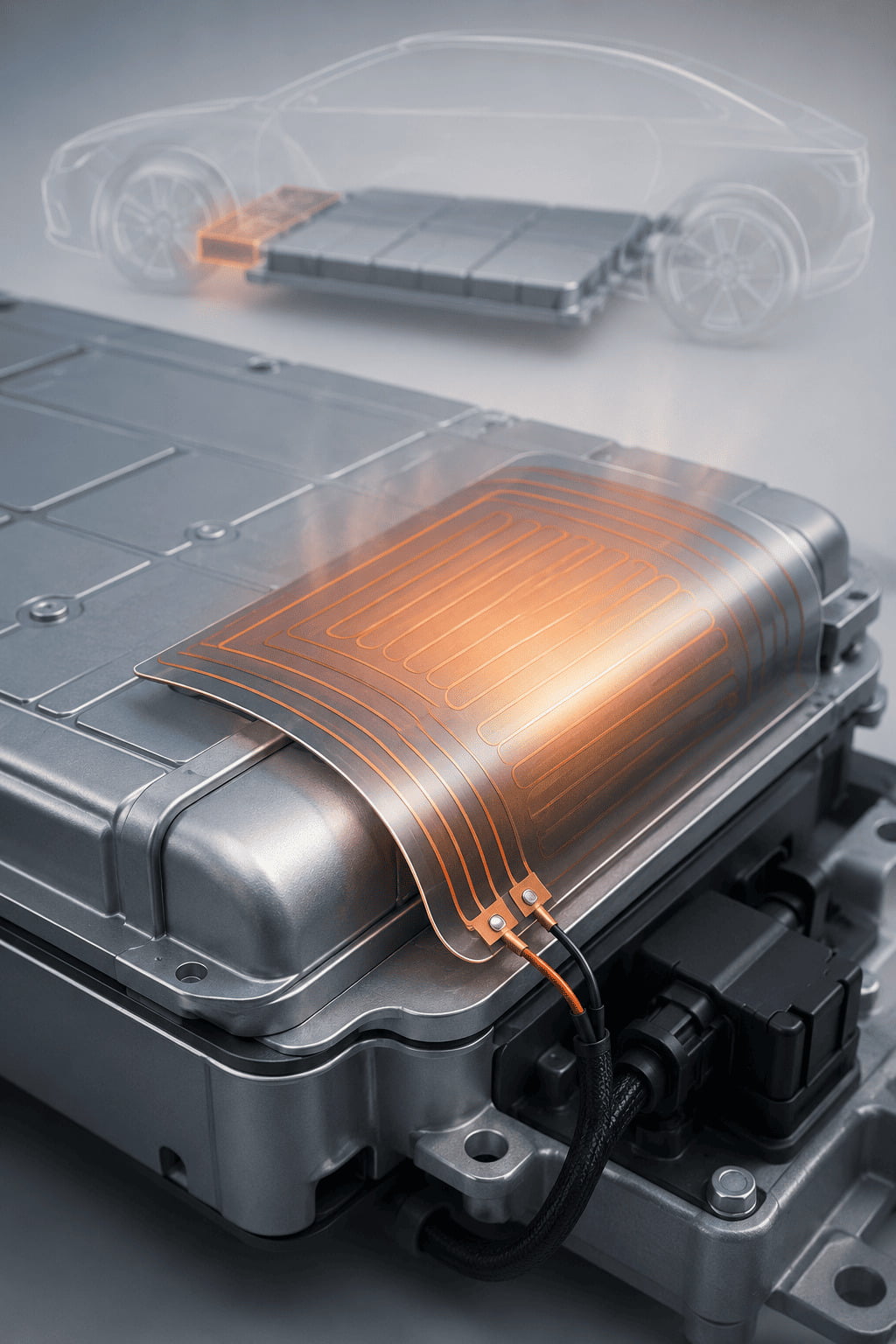
Choose a thin film heater when your application demands lightweight, flexible, or localized heating in very tight spaces. They are ideal for tasks like preventing condensation on sensors 3 or gently warming a specific component, not for high-power cabin heating.
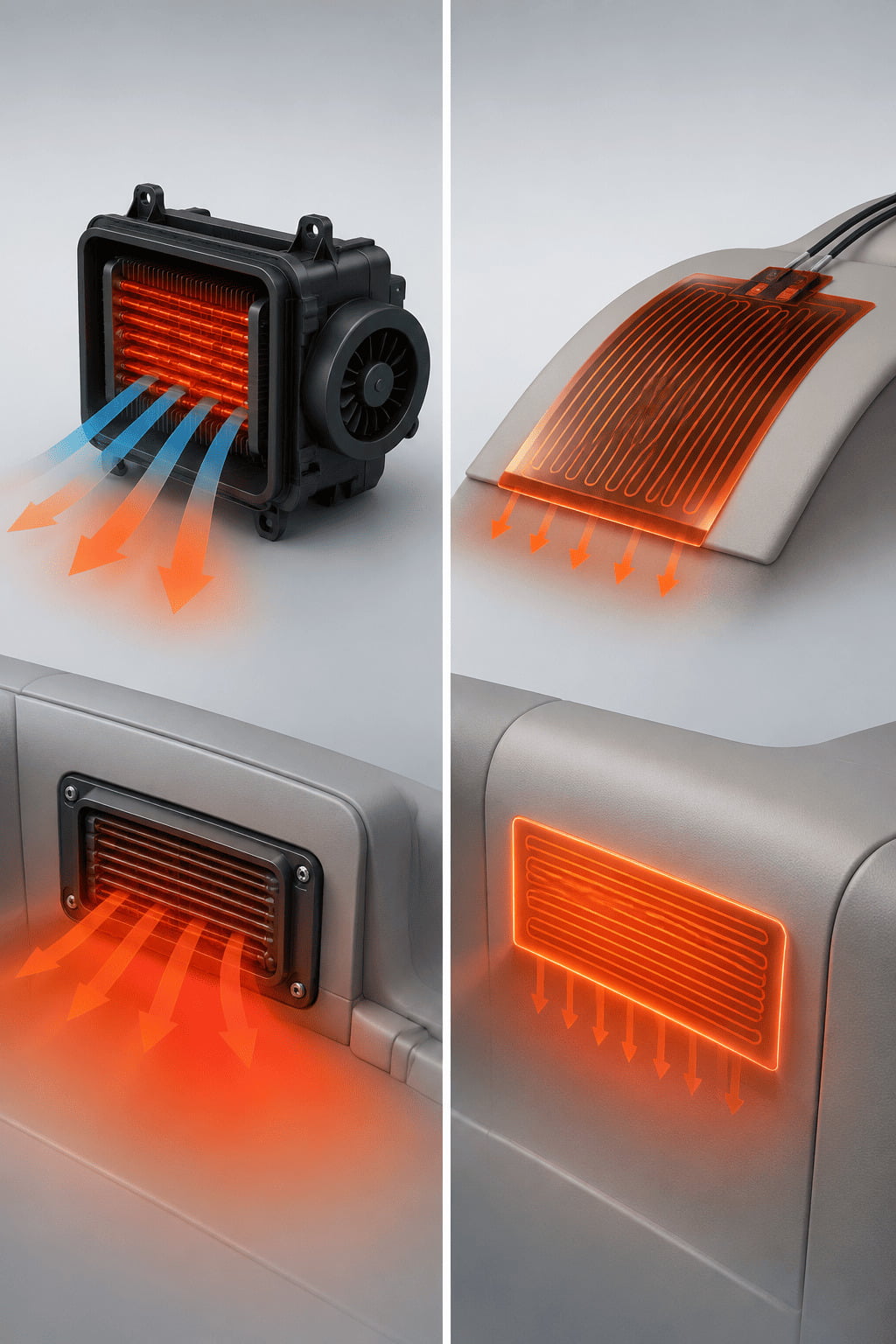
The most common mistake I see is thinking of thin film heaters as a direct, one-to-one replacement for traditional heaters like PTC air heaters 4 or coolant heaters. This is the wrong way to look at it. They are different tools for different jobs. A powerful PTC heater is great for warming up a large space quickly, but it's also heavy, bulky, and power-hungry. A thin film heater can't do that job. However, if you need to apply a small amount of heat directly to a specific surface, a thin film heater is often the best choice. It’s about picking the right tool. Think of it less as "new vs. old" and more as "specialized vs. general purpose". We need to move the conversation from which technology is "better" to which technology is the "better fit" for the specific task you need to accomplish.
| Feature | Traditional Heaters (e.g., PTC) | Thin Film Heaters |
|---|---|---|
| Best For | High-power, area heating (e.g., cabin air) | Localized, surface heating in tight spaces |
| Form Factor | Bulky, rigid structures | Ultra-thin, flexible, conformable to surfaces |
| Weight | Heavy | Extremely lightweight |
| Heat Distribution | Often requires a fan to distribute heat | Direct surface contact, even heat |
| Integration | Needs significant space and mounting brackets | Simple adhesive mounting, fits into gaps |
| Typical NEV Task | Main cabin heating, battery coolant heating | Sensor anti-fog, mirror defrost, component pre-heating |
How Do You Evaluate Thin Film Heaters Beyond the Price Tag?
It's tempting to focus only on the unit price from a supplier. But a cheap part that causes expensive failures or assembly line headaches is no bargain. You must look at the total picture.
Evaluate thin film heaters by defining the precise heating task first. Then consider structural integration, wiring methods, control logic, and long-term reliability. A low price means nothing if the heater is difficult to install or fails in the field.
Many overseas procurement managers I speak with see reports about the fast-growing NEV market and assume they must adopt every new technology to stay competitive. This is a dangerous assumption. Market growth does not mean a technology is simple to implement. For thin film heaters, the real challenge isn't finding a supplier who can make them cheap; it's finding a partner who ensures they work reliably within your specific system. Before you even ask for a quote, you should have clear answers to a list of questions. A good supplier should be asking you these questions, too. If they only talk about price, that's a red flag. The focus must be on reducing risk for your project, and that means looking far beyond the component itself.
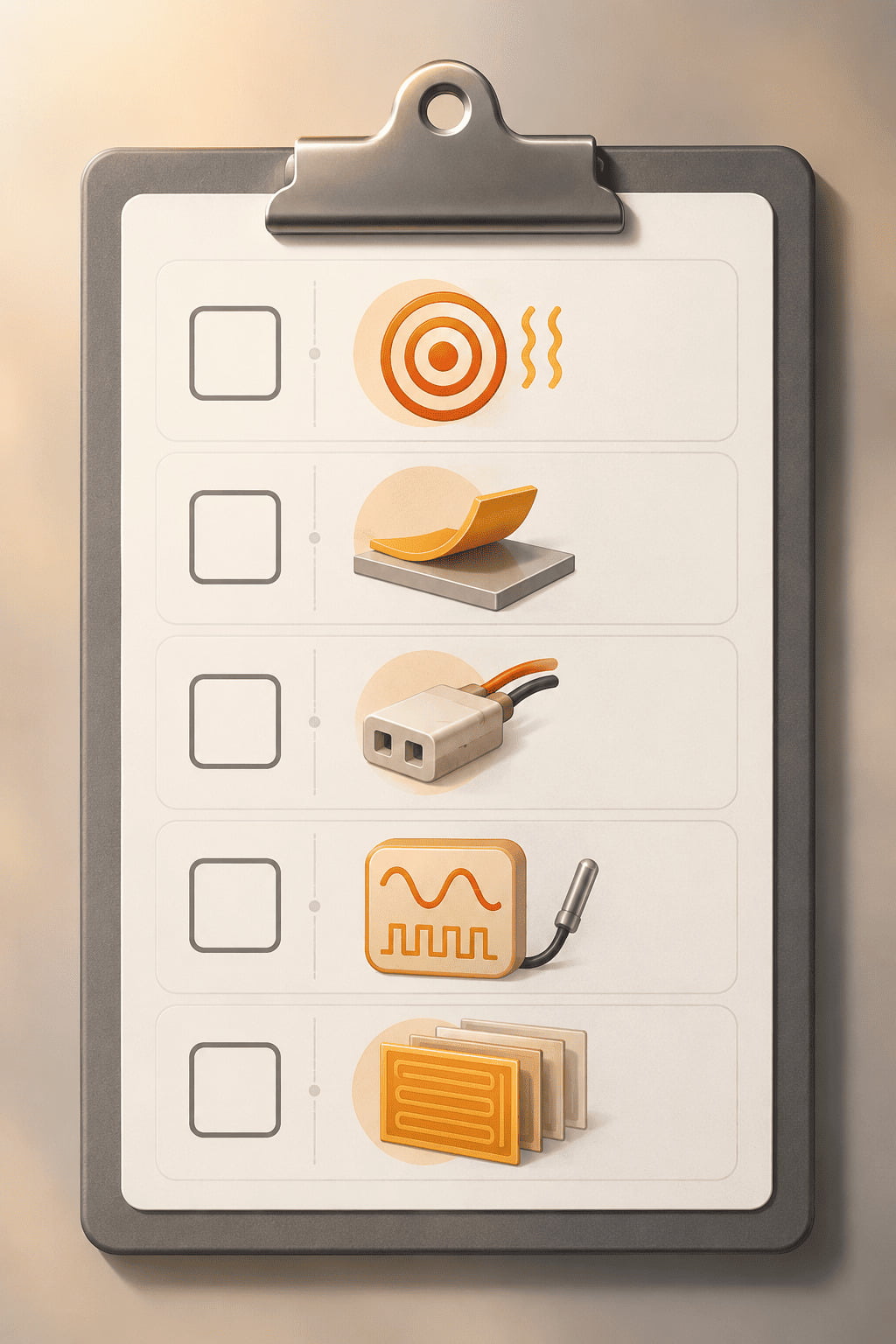
Key Evaluation Checklist
- Task Definition: What exactly are you heating, and why? Is it to prevent ice on a camera lens? Is it to keep a small electronic component at a stable operating temperature? The power, size, and shape of the heater all depend on this.
- Structural Integration: How will the heater be mounted? Most thin films use an adhesive backing 5. What surface is it sticking to? Is that surface clean? Is it curved? The adhesive choice is critical for long-term performance.
- Electrical Connection: How will you connect the heater to the power source? Will it use a standard connector or custom flying leads? This detail has a huge impact on assembly line efficiency and reliability.
- Control Logic: Is this a simple on/off heater, or does it need precise temperature control using a sensor and a PWM signal 6? The control strategy impacts the entire electrical architecture.
- Batch Consistency: Will the 10,000th heater perform exactly like the first sample? This is a question of your supplier's process control.
What Production Details Affect the Reliability of Thin Film Heaters?
You have received a perfect sample from a potential supplier. It works great. But now you have to order 50,000 units. How do you know they will all be the same?
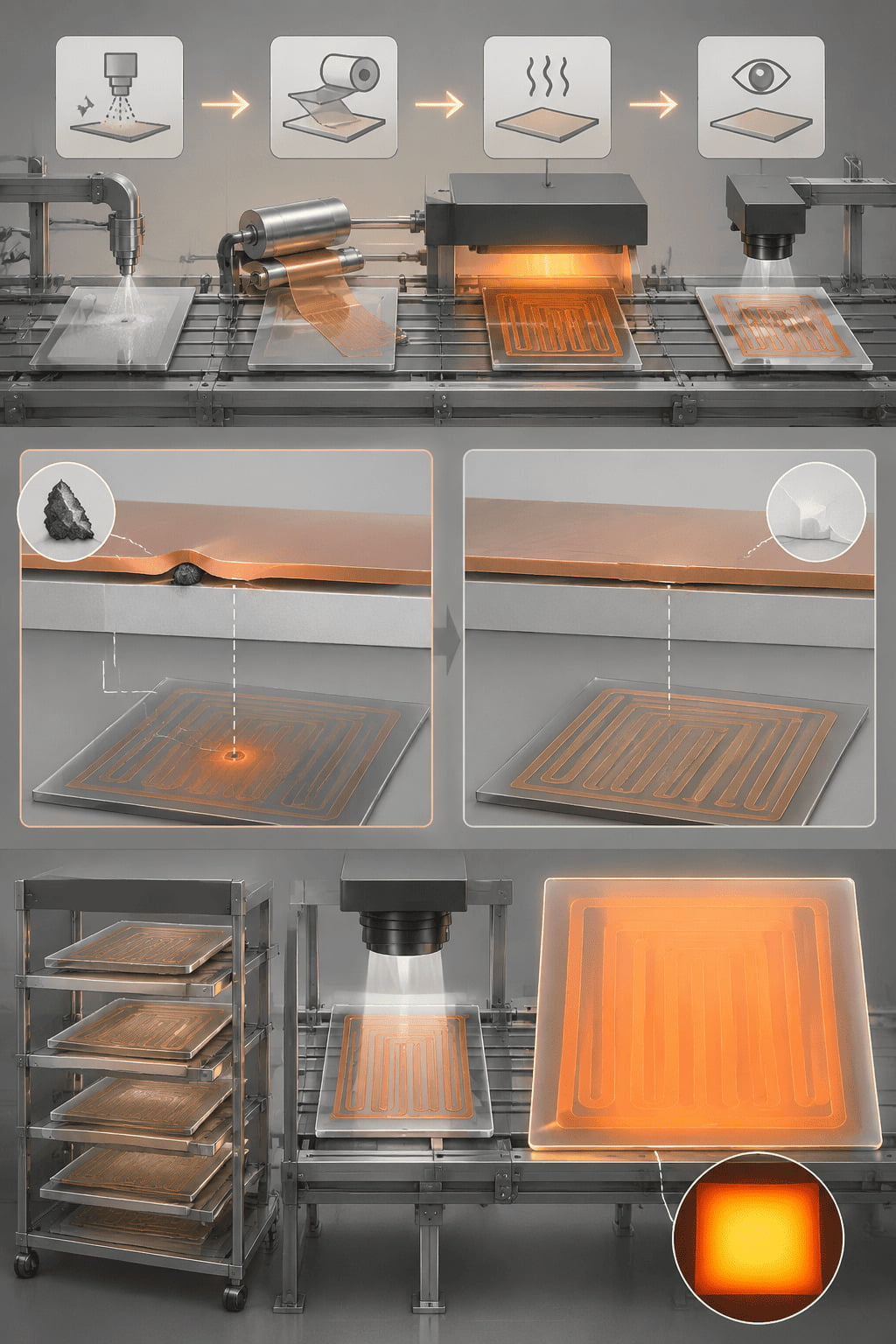
The reliability of thin film heaters depends heavily on controlling the manufacturing process. Key factors include the etching process for the heating circuit 7 and the surface preparation of the substrate. Inconsistent production can lead to hot spots and premature failure.
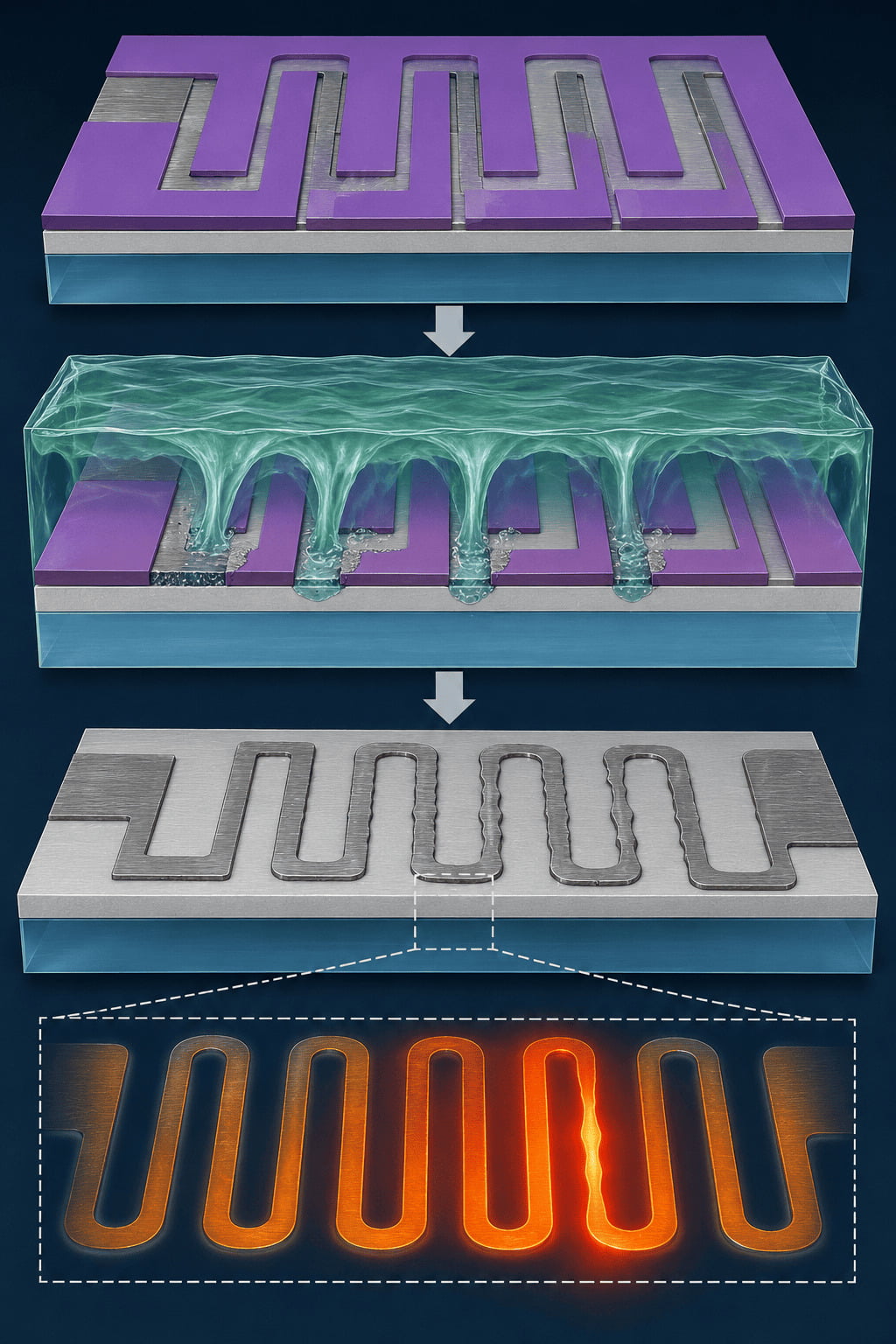
From my perspective managing supply chains in China, this is where many projects run into trouble. The beautiful sample that worked in your lab was made under perfect conditions. Mass production is a different story. For thin film heaters, two areas are especially critical. The first is the etching process. This is how the heating pattern is created on the film. If the process is not tightly controlled, the width of the etched lines can vary. A line that is too thin creates higher resistance, which becomes a "hot spot". This spot gets much hotter than the rest of the heater, leading to rapid degradation and failure. The second area is surface morphology 8, which is just a technical way of saying how clean and prepared the surface is before the heating element is applied. Any tiny dust particle, oil, or moisture can create a bubble or a weak spot in the adhesion. Over time, with thermal expansion and contraction 9, this spot will grow and cause the heater to delaminate and fail. As your partner in China, our job isn't just to place an order; it is to be on-site, supervising these critical process steps to ensure the 50,000th part is identical to the first.
Why Is Early Supplier Involvement Critical for Thin Film Heater Integration?
Your engineering team has finalized the design for a new module. Now you just need to find a supplier to make the parts. But when you send out the drawings, suppliers tell you it's difficult or expensive to make.
Involving a heater supplier early prevents costly redesigns. An expert can help you match the right technology to your task and ensure the design is manufacturable before the vehicle's structure is finalized. This saves everyone time, money, and headaches.
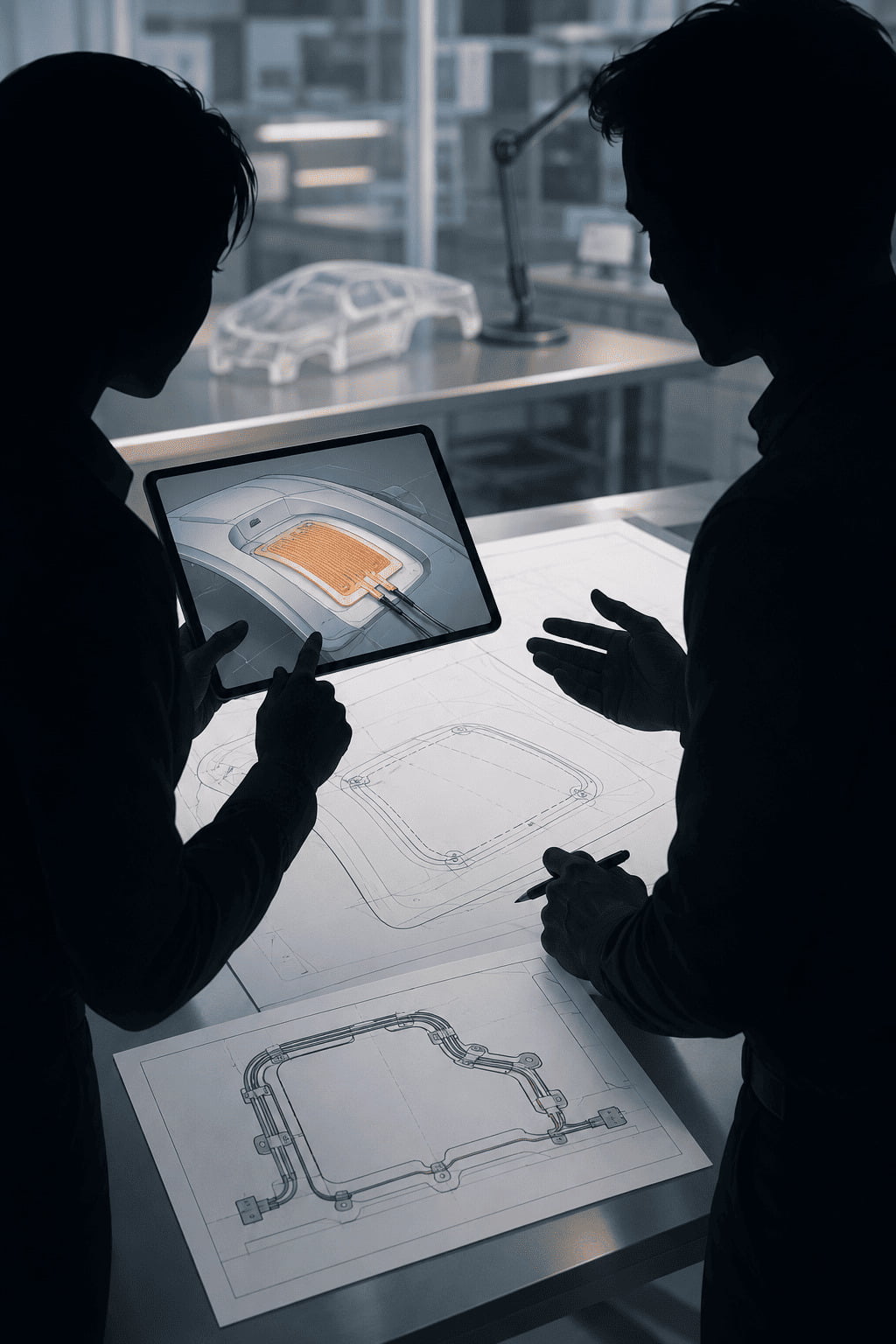
I remember a client who came to us after their entire module design was frozen. The mechanical engineers had left a tiny, oddly shaped space and said, "put a heater here." Because the design was already fixed, the only solution was a highly complex and custom-shaped thin film heater. It was expensive to develop, and the awkward shape made it very difficult for workers to install correctly on the assembly line, leading to quality issues. If they had spoken with us just six months earlier, during the initial design phase, we could have pointed out a much simpler solution. A small change to a plastic rib would have created space for a standard, rectangular heater that cost 70% less 10 and was simple to install. This happens all the time. When the purchasing and engineering teams see the heater as the last component to source, they create unnecessary risks and costs for themselves. Bringing a capable supplier into the conversation early is the single best way to reduce risk.
Benefits of Early Supplier Involvement:
- Optimized Heater Selection: Get expert advice on whether a thin film, PTC, or other type of heater is the best fit.
- Design for Manufacturing (DFM) 11: The supplier can provide input to make the part easier and cheaper to produce at scale.
- Simplified Integration: Plan for wiring, connectors, and mounting methods from the start.
- Reduced Supply Chain Risk: Lock in a manufacturable design with a capable partner early on.
Conclusion
Thin film heaters offer great solutions for specific NEV tasks. Success depends on defining the task first, evaluating the entire system, and involving your supplier early in the design process.
"U.S. share of electric and hybrid vehicle sales increased in the ... - EIA", https://www.eia.gov/todayinenergy/detail.php?id=62924. Multiple industry analyses document substantial year-over-year growth in global NEV sales and market penetration, with projections indicating continued expansion through the next decade. Evidence role: statistic; source type: research. Supports: Market research data showing growth trends in the New Energy Vehicle sector. Scope note: Market forecasts vary by region and are subject to policy changes and economic conditions ↩
"Characteristics of the PTC Heater Used in Automotive HVAC Systems", https://www.academia.edu/115876281/Characteristics_of_the_PTC_Heater_Used_in_Automotive_HVAC_Systems. Engineering literature documents that conventional PTC heating elements typically measure several centimeters in thickness and weigh hundreds of grams, while thin film alternatives can achieve sub-millimeter profiles with proportionally reduced mass. Evidence role: statistic; source type: research. Supports: Technical specifications comparing dimensional and mass characteristics of different automotive heating technologies. Scope note: Specific measurements vary widely based on power rating and application requirements ↩
"Camera Lens Heater: How to Prevent Fogging & Icing in ADAS ...", https://www.ptc-heater.com.tw/camera-lens-heater-adas-anti-fog-deicing/. Automotive engineering studies describe the application of low-power thin film heaters to maintain sensor surfaces above dew point temperatures, particularly for camera and LiDAR systems in advanced driver assistance applications. Evidence role: case_reference; source type: research. Supports: Documentation of thin film heating elements used in automotive sensor systems for condensation management. ↩
"Self-regulating heater - Wikipedia", https://en.wikipedia.org/wiki/Self-regulating_heater. PTC heaters utilize ceramic materials with positive temperature coefficients of resistance, providing self-regulating heating behavior widely adopted in automotive climate control systems due to inherent temperature limiting characteristics. Evidence role: definition; source type: encyclopedia. Supports: Technical explanation of PTC heating technology and its automotive applications. ↩
"Which mounting attachment method should be used for flexible thin ...", https://www.jaye-heater.com/info/which-mounting-attachment-method-should-be-use-69261080.html. Technical literature on flexible heating elements describes pressure-sensitive adhesive backing as a prevalent mounting solution, offering conformability to curved surfaces and simplified installation compared to mechanical fastening methods. Evidence role: general_support; source type: research. Supports: Documentation of adhesive mounting as a standard attachment method for thin film heaters. ↩
"Pulse-width modulation - Wikipedia", https://en.wikipedia.org/wiki/Pulse-width_modulation. Pulse Width Modulation is an established electronic control technique that regulates average power delivery by varying the duty cycle of a switching signal, commonly applied to heating element control for precise temperature management without analog circuitry. Evidence role: definition; source type: encyclopedia. Supports: Technical explanation of PWM as a control methodology. ↩
"[PDF] Practical Thin Film Technology - Cornell NanoScale Facility", https://www.cnf.cornell.edu/sites/default/files/inline-files/CNFNanoCoursesSection3.pdf. Manufacturing literature describes chemical or laser etching processes that selectively remove conductive material to create precise resistive heating patterns on flexible substrates, with pattern accuracy directly affecting heating uniformity. Evidence role: mechanism; source type: research. Supports: Technical description of etching processes used in thin film heater manufacturing. ↩
"[PDF] Surface Morphology", https://djena.engineering.cornell.edu/hws/tsao_chapters_mbe_II.pdf. Surface morphology refers to the topographical and physicochemical characteristics of a material surface, including roughness, cleanliness, and chemical composition, which critically influence adhesive bond formation and long-term joint integrity. Evidence role: definition; source type: encyclopedia. Supports: Definition of surface morphology in materials science context. ↩
"Thermal Fatigue of Adhesive Bonding in Modular Additively ...", https://www.purdue.edu/undergrad-research/ourconnect/index.php?q=projectview&id=1234. Materials science establishes that repeated heating and cooling cycles induce dimensional changes governed by thermal expansion coefficients, and mismatches between bonded materials generate interfacial stresses that can propagate delamination over time. Evidence role: mechanism; source type: education. Supports: Materials science principles explaining thermal expansion effects on bonded assemblies. ↩
"[PDF] Supplier Involvement in Product Development", https://minds.wisconsin.edu/bitstream/handle/1793/85664/Frie%2C%20Joslyn.pdf?sequence=1&isAllowed=y. Manufacturing case studies document that early supplier involvement in product design phases can achieve cost reductions ranging from 20% to over 50% through design simplification and manufacturability improvements, though specific savings vary by application complexity. Evidence role: general_support; source type: research. Supports: General evidence that early design collaboration can yield substantial cost reductions. Scope note: The cited 70% reduction represents a specific anecdotal case rather than a generalizable benchmark ↩
"Design for manufacturability - Wikipedia", https://en.wikipedia.org/wiki/Design_for_manufacturability. Design for Manufacturing is an established engineering practice that integrates manufacturing process considerations into product design phases, systematically reducing production complexity, cost, and quality risks through early identification of manufacturability constraints. Evidence role: definition; source type: education. Supports: Explanation of Design for Manufacturing as an engineering methodology. ↩